- Spark Intelligence
- Posts
- Spark Intelligence #45: Only 15% of agencies have built AI into how they actually operate. Where do you sit?
Spark Intelligence #45: Only 15% of agencies have built AI into how they actually operate. Where do you sit?
The AI brief for creative leaders to grow your business and career, by Spark AI

Emma Wharton Love
March 30, 2026
👋 Greetings earthlings,
Emma here, co-founder of Spark AI. We've been sitting on some numbers from our upcoming Spark Report (our 6 monthly benchmark of AI adoption in agencies) and I can't keep them to myself any longer. If you run an agency, you're going to want to check yourself against these.
Also in this edition: Jules has given us the latest copyright and tool updates before disappearing off-grid to ski in Norway, lucky thing (I can’t say too much, I've just got back from a few days in the sun myself – end of a busy Q1 demands it!)
What's inside:
A first look at The Spark Report: AI adoption in agencies benchmark
We've been running this research every six months since 2024, and this edition is a big one! We tried to keep it tight but there was too much to cut. The first half covers where agencies actually are with AI right now, with detailed case studies. The second gives you practical frameworks for what to do next. (Don't worry, there's an exec summary for those of you who just went pale.) | 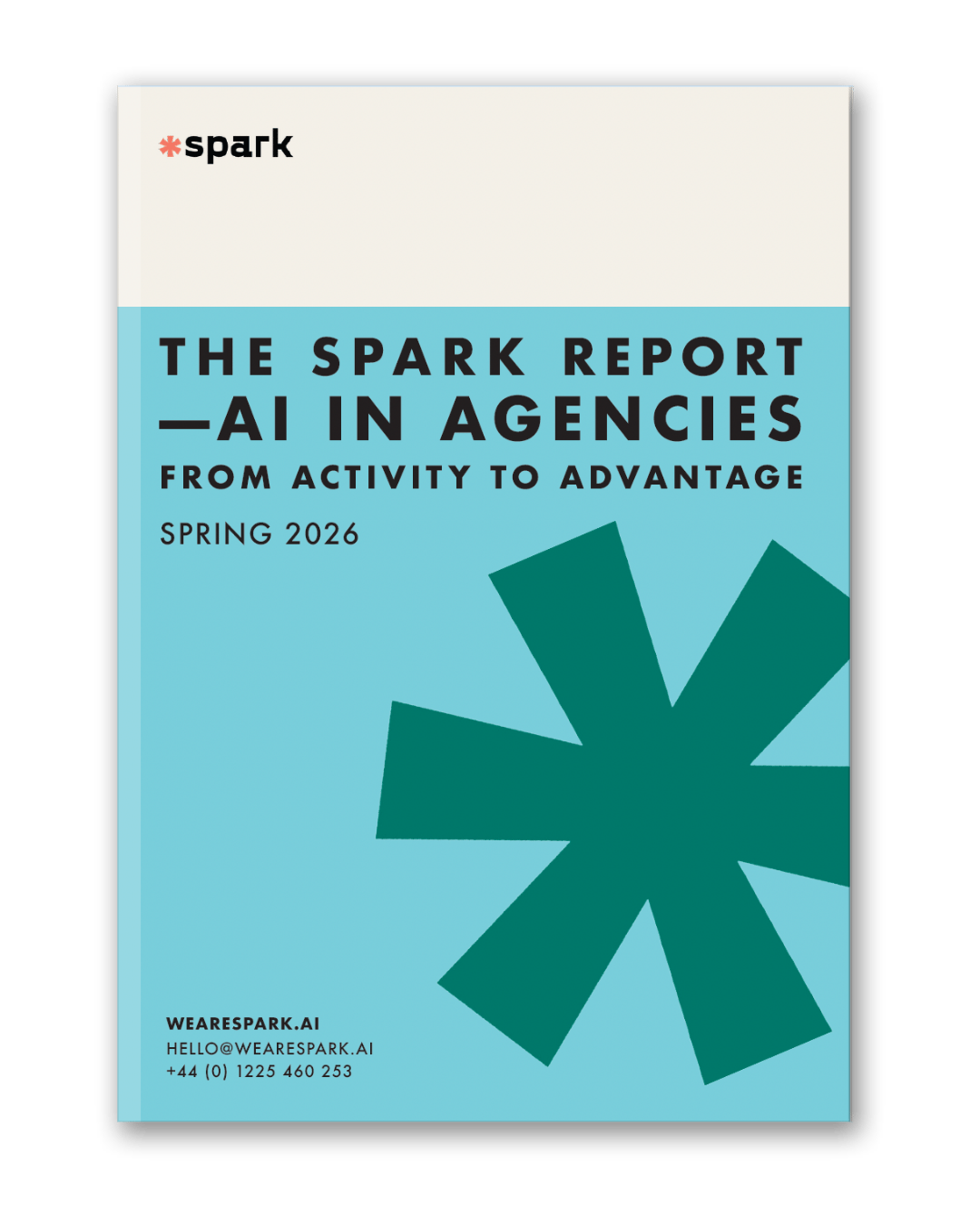 |
If I had to pick one finding that really jumped out, it's this: agency teams have moved past the experimentation phase. They're using AI regularly and they feel confident doing it. But what we're actually seeing is still good but basic prompting – people don't know what they don't know. 83% say they're confident with AI. But only 15% of agencies are building AI into the way their business actually operates. That means AI strategy, governance, commercial positioning and skills remain stuck at the earliest stage of maturity – creating a widening gap between what teams are doing with AI and what their organisations are set up to support.
The consequences run in both directions: without governance, agencies are exposed to risk around IP, data, and client confidentiality. Without strategy, they're leaving measurable gains in efficiency, creative capacity, and competitive positioning on the table.
What separates the 15% from everyone else
Agencies making real progress are asking the hard questions:
How does AI reshape our business model?
How do we build repeatable workflows that deliver genuine value to clients, not just internal time savings?
How do we make sure the whole team is engaged, not just a handful of enthusiasts?
These are leadership questions, not technology ones – and the answers show up in client conversations and in valuations.
Clients are paying closer attention now. They want to know you're handling their data responsibly. Our research found that 52% of agencies currently have no formal governance in place – no whitelisted tools, no training on data handling.
Clients also want to see what you can actually do. Being ready for both is increasingly a determining factor in winning pitches and in M&A. And the commercial difference between agencies that have embedded AI and those still experimenting is becoming harder to ignore.
Getting there means treating AI like the organisational change it is. Training that goes beyond basic prompting. Clear rules about what data goes into which tools. A team that can answer confidently when a client asks how you're using AI in their work.
One thing to try this week
Over the last couple of years our research consistently shows that the biggest barrier to AI adoption is capacity – and that's still the case. People want to get better at this. They just can't find the time between client work and everything else.
So do something simple: ringfence time for AI experimentation. Block an hour a week, for yourself and your team, with no deliverable attached. Just space to try things and build familiarity. This sounds basic, but our research consistently shows capacity is still the biggest barrier, even for experienced teams.
The full report AI in Agencies: From Activity to Advantage drops mid April. It’s the clearest picture yet of where the industry actually is with AI – and what the agencies getting it right have in common. Be one of the first to receive it:
What Team Spark has been up to
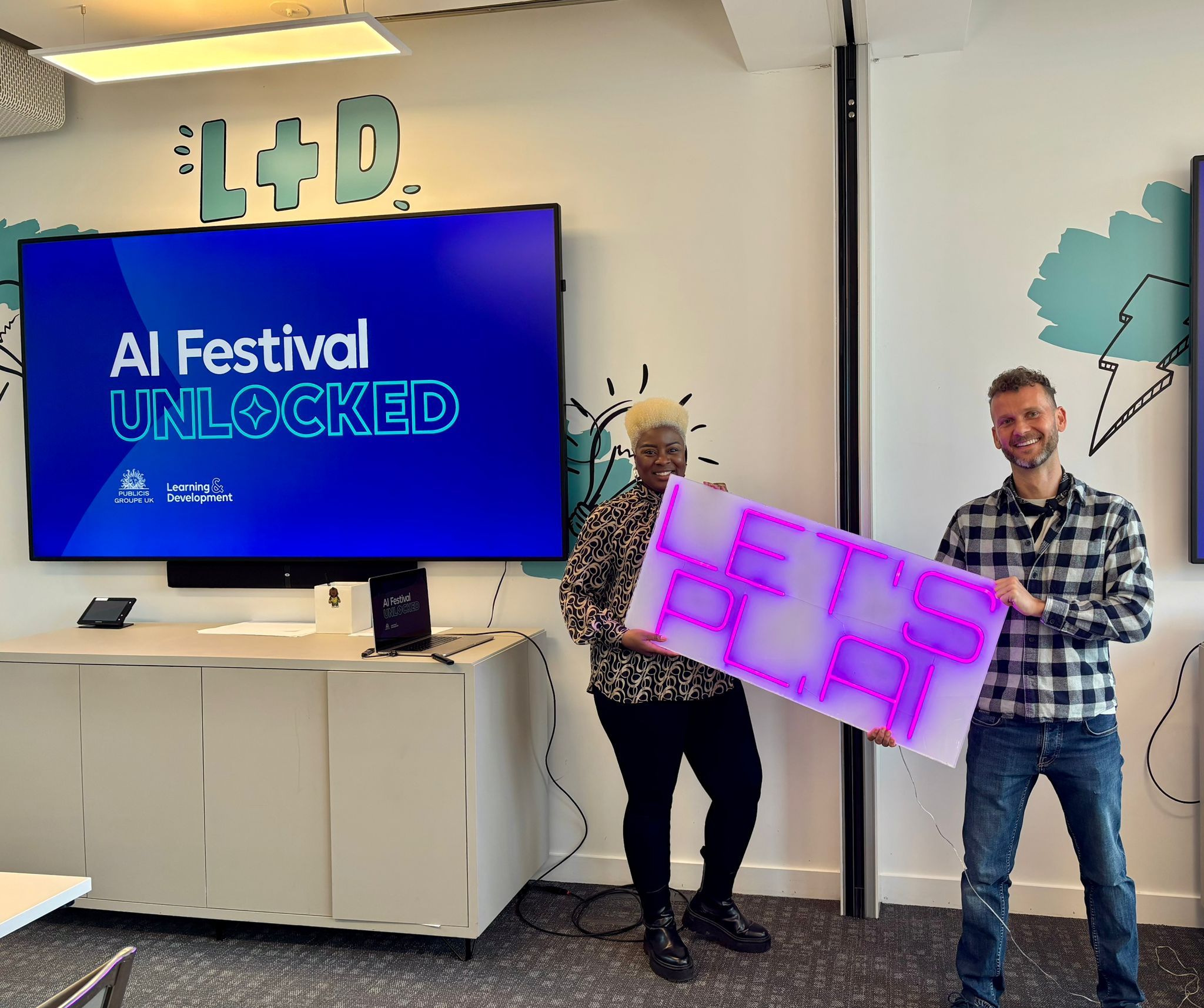
Simone and Jonas at running a workshop at Publicis AI Festival
It's been a full fortnight. We've been zooming everywhere running AI programmes across leadership, creative, strategy and client services teams with clients including Publicis (part of their brilliant AI festival), JKR, PB Creative, Neverland Creative, SampsonMay, Epoch and WHAM brand group and Grande Cosmetics.
Three of our AI Accelerator coaches – Dr Matthew Maxwell, Rob Crow and Simon Helm – gave a sneak peek into the AI for Creatives programme they run at Agency Hackers' The Robots Are Coming at the British Library. It was a jam-packed room and they demoed how creative teams are moving beyond juggling isolated AI tools toward node-based workflows – think Figma-style canvases where image, video and text models all connect like Weavy, now in fact Figma Weave. The practical payoff of these tools for agencies being: when the client asks you to change the shirt colour or swap the background, you rerun the workflow instead of reshooting. Once you've built the engine, you just change the ingredients. What surprised us was how few people in the room were using these tools yet – which tells you something about where the opportunity still sits. Drop me a line if you’d like more information about our AI for Creatives programme - part of our AI Accelerator.
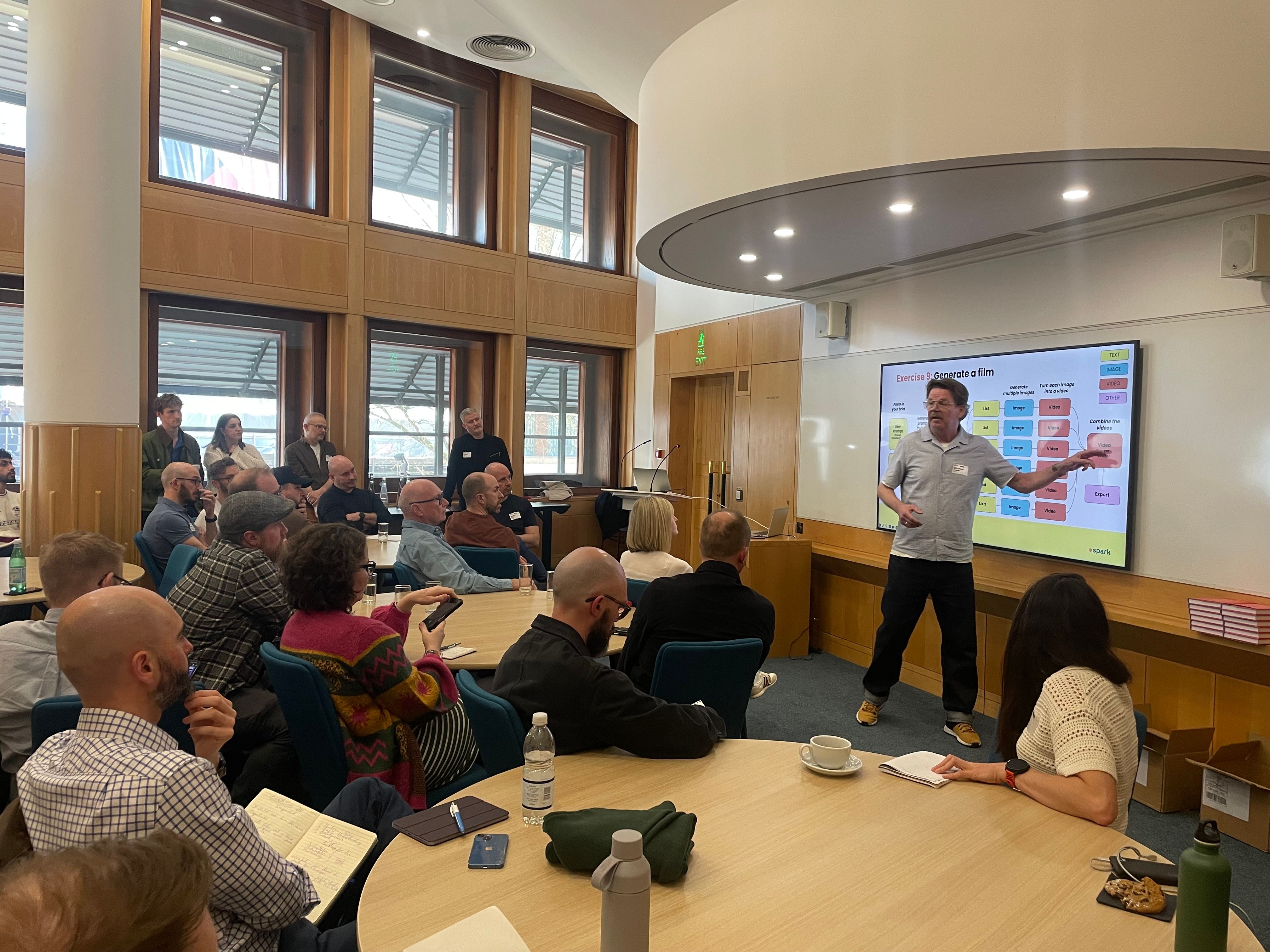
Matthew, Simon and Rob leading the creative AI way at Robots
Jules and I were both at BenchPress Live at Battersea Arts Centre for The Wow Company's latest agency benchmarks. One thing really stood out: last year, agencies that had fully embedded AI across their business were making 9% more profit than the rest. This year that gap has dropped to 3%. Don't misread that – it doesn't mean the advantage of investing in AI is shrinking. It means everyone else is catching up. We're no longer in the early adopter phase – AI adoption in agencies has gone mainstream. If you've been meaning to get serious about AI, this is a good time to start.
The UK government finally published an update on its AI and copyright consultation
Jules here. The UK government released its long-awaited report on copyright and artificial intelligence this month, and if you were expecting clarity, brace yourself.
After a public consultation that drew over 11,500 responses – the vast majority from the creative industries – the government has essentially decided not to decide. No new law. No broad exception. No strengthened protections. Just a commitment to gather more evidence, monitor international developments, and come back to it later. Which, depending on where you stand, is either frustrating or quietly reassuring. |  |
The backstory in brief
The report, published under the Data (Use and Access) Act 2025, examined four possible approaches to how AI developers can use copyrighted material for training. The government's original preference – a broad "opt-out" exception, where AI companies could train freely on published content unless rights holders actively blocked it – was roundly rejected by the creative industries in consultation. The backlash was significant enough that it's now been formally abandoned as policy.
So where does that leave things? In legal limbo, for the time being.
AI companies like Anthropic and OpenAI still have no specific right to train on copyrighted UK material without a licence. And rights holders have no new tools to stop them. Both sides are watching US litigation and EU regulation unfold before the UK commits to anything.
Why this matters if you're an agency
For most of the agencies we work with, you're not on one side of this argument. You're both.
On one hand, your creative output – the brand copy, the campaign visuals, the photography, the design systems – is exactly the kind of material that gets scraped and used to train AI models. The report acknowledges this directly. It notes that AI models would not be able to learn without human creativity and that their outputs may compete with the very creators they learn from. The government wants rights holders to be able to enforce those rights. It hasn't yet said how.
On the other hand, many agencies are now producing AI-generated content – images, copy, concepts – for clients as part of their everyday workflow.
And there's a separate issue buried in the same report that has significant implications for that work: the government has proposed removing UK copyright protection for wholly AI-generated works.
At the moment, the UK is actually unusual in offering any protection at all for computer-generated content without a human author – a quirk that's been on the books since 1988. The report proposes scrapping it. Under the proposed change, if an image or piece of copy is generated entirely by AI with no meaningful human authorship, it wouldn't qualify for copyright protection. That has real implications for clients who may assume that AI-generated assets they've commissioned and paid for are protected as their intellectual property. They might not be.
What agencies should actually do with this
The honest answer is that the legal picture is still uncertain, and will be for some time. But a few things are worth acting on now.
First, if you're using AI tools to generate creative assets for clients, it's worth being explicit in your client agreements about the IP status of that work. Don't let clients assume protection exists where it may not. The distinction between AI-assisted work (where a human has made meaningful creative choices) and wholly AI-generated output matters – legally and commercially.
Second, if you're concerned about your own work being used to train AI models, the report indicates that transparency obligations on developers are likely to come, even if slowly. Technical tools for controlling how your content is accessed by web crawlers are developing, and it's worth staying across them. The government explicitly proposes to support best practice in this area.
Third – and perhaps most importantly – don't sit back and assume this will be resolved for you. The government is watching the market develop. In the meantime, the licensing frameworks that emerge between now and any new legislation will shape the landscape for years. Agencies that understand the stakes, and can articulate them to clients, will be better placed than those who treat this as a legal question for someone else to answer.
The government has pressed pause. But the AI industry hasn't.
Tool update: Midjourney V8
Midjourney released an alpha preview of V8 this month. Generation is roughly five times faster, there's a native 2K HD mode, and text rendering in images has improved noticeably. The model is also much better at following detailed prompts – and your existing moodboards and personalisation profiles carry over from V7. Relaxed mode is now available too, so you can iterate without watching your credits disappear. It's currently only available at alpha.midjourney.com, and the premium features cost 4x the GPU time.
A word of caution though: this is genuinely alpha. Midjourney have said the current version is temporary and a significant update (possibly V8.1) is weeks away, with changes to default aesthetics, coherence and resolution. I was chatting to Rob Crow about this – one of our three specialist creative AI coaches on the Accelerator programme – and he made the point that every new Midjourney model requires a shift in prompting style, which can be frustrating when you've built up prompt libraries that worked well in V7. Worth testing – but don't rebuild your workflows around it yet.
Rob also noticed something interesting in his early testing: V8 is showing greater reluctance to move away from conventional notions of beauty than V7 did. If diversity in your AI-generated imagery matters to you (and it should), keep an eye on that as the model develops.
In practice what's emerging is a hybrid approach – Midjourney for ideation and invention, then a tool like Nano Banana for clean-up and consistency. Midjourney still sits outside the node-based workflow platforms I talked about above that are becoming the standard for production work. We teach our AI for Creatives Accelerator programme on these platforms – and fellow creative AI coach Dr Matthew Maxwell put it well when I chatted to him about it: Midjourney may end up as the top-end specialist tool for individual creators, but its lack of integration with platforms like these poses problems for studio working methods. For agencies thinking about creative AI at scale, the tool you choose is starting to matter less than the workflow it fits into.
Are you using Midjourney? |
That's all for this edition - I hope you found it helpful. See you next time!
Co-founder, Spark AI
What did you think of our email today? |
About Spark AI
Spark AI helps you lead your team through the biggest shift since digital, with AI training, transformation and tools. We've worked with 60+ agencies, published the
#1 bestselling book on AI for Agencies, and teach at Oxford University.