- Spark Intelligence
- Posts
- Spark Intelligence #41: Is AI making your agency faster or just more exhausted?
Spark Intelligence #41: Is AI making your agency faster or just more exhausted?
The AI brief for creative leaders to grow your business and career, by Spark AI

Emma Wharton Love
February 16, 2026

👋 Greetings earthlings,
Emma here, co-founder of Spark AI. I've been wrestling with a paradox which I wonder if you’ve been feeling too: how can AI be so life-changingly helpful and yet leave us all so tired? AI saves time – no question. But on the flip side, it opens up possibilities. And possibilities, it turns out, are exhausting.
Three things landed on my radar this fortnight that snapped this into focus. First, our lead creative AI coach Dr Matthew Maxwell (yes Dr, congratulations Matthew for getting your PhD in creativity and AI, what an achievement!) wrote a beautiful piece about welcoming AI as a new colleague - featured below. Second, Wharton professor Ethan Mollick flagged new research showing AI productivity gains are tipping into burnout. And then Morgan Stanley published survey data revealing just how fast adoption is moving – and what it's costing.
The thread connecting all three – a message I relentlessly talk about – AI adoption was never a technology problem. It's a leadership one. And if we don’t lead it proactively our teams will feel exhausted by not excited by the possibilities of AI.
In store for you today:
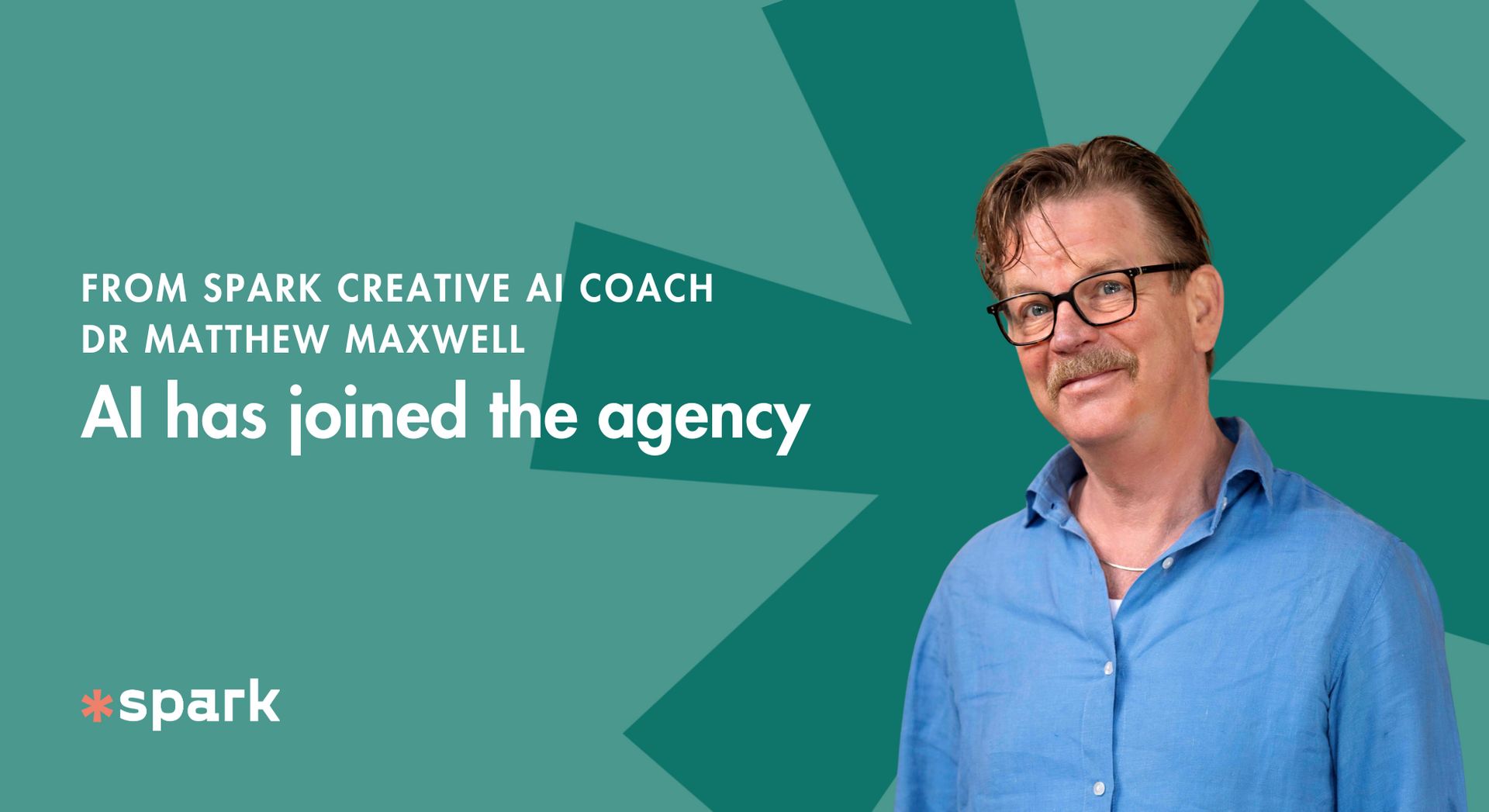
AI has joined the agency
By Dr Matthew Maxwell, Lead Creative AI Coach at Spark AI
Often, it's the quiet ones you need to look out for.
Covid taught me that: some minds work best in the dark, alone.
I realised that the opinionated, flamboyant talents I typically hired said more about me than them. I liked the bantz and craic and the jolly back-and-forth of a busy studio. But I discovered that pandemic isolation – and the remote-working it spawned – seemed to draw out something valuable from the quietest of sources. The introverts. The deeper thinkers.
A new hire
In today's creative agencies, a stealthy new colleague has shimmered into the room and taken a seat at the table. And this softly spoken, shy and self-effacing creature turns out to be exceptionally talented.
It goes by many names: ChatGPT, Gemini, Weavy, among others. But seems happy to answer to its nickname: "AI".
AI is always on call. AI never complains. It researches back stories, trends and markets. It quietly comes up with concepts and hooks. It ideates, explains and cajoles. It seems able to do everything. Without fuss. Tirelessly. Automatically.
For teams under constant pressure to deliver faster, cheaper, and more, this newbie might seem like a godsend. Fewer blank pages. More options. Less friction.
What about the humans?
But these gains also highlight the contribution AI's human colleagues bring to the party.
Creative work has always drawn its power from lived experience: cultural awareness, emotional intelligence, instinct sharpened through failure, taste developed over time. This knowledge resists reduction to datasets. It's earned. When automation begins to lead rather than support, creative work risks drifting toward the average — efficient, competent, and strangely hollow.
The danger isn't that AI replaces creativity. It's that it tempts us to stop reaching for it.
Used well, AI-powered automation expands the field of possibility. It helps explore directions faster, tests visual languages, provokes unexpected combinations.
Used poorly, it compresses thinking, encourages aesthetic shortcuts, dulls authorship.
Like any new hire, especially one this gifted, AI needs careful onboarding and empathetic managing. For agencies, the opportunity lies in redefining creative partnership: let the machines propose, remix, and accelerate. But insist that humans judge, frame, and decide what matters. Inspiration still comes from people – from observation, curiosity, disagreement, and risk — not from optimisation.
The challenge for leaders
The most compelling brand work ahead won't reject automation or surrender to it. It will be shaped by creatives who know when to lean on AI, and when to step away from it. When to listen and when to argue. How to work with this strange new colleague, whose relentless work ethic is off the charts, and whose quiet, inexhaustible omniscience seems as destabilising and alien as the opportunities it reveals.
But, as I learned when the studios closed, knowing how to interact with 'other' intelligences is a critical agency skill. Capitalising on strengths while supporting weaknesses. We talk a good talk on inclusivity, neurodiversity, and 'teamwork making the dream work'. Well, now is the time to prove it.
Leaders – your task remains the same. Getting the best out of your new AI colleague means deploying it where and when its skills and energy can do the most good, folding it into workflows so the disruption it brings can be positive, not damaging. An accelerant, not a wildfire.
So welcome onboard, AI! You're part of the team.
What we're watching
The burnout nobody saw coming
Ethan Mollick – Wharton professor and one of the sharpest voices on AI and work – argued last week that telling workers to "just use AI to do stuff" has never been a sufficient strategy, and the problem is getting worse as AI gets better. This is something we see constantly in agencies – and it's backed up by a new HBR article by UC Berkeley researchers Aruna Ranganathan and Xingqi Maggie Ye which I’ve summarised here:
The HBR piece studied a 200-person tech company over eight months. What they found challenges the comfortable narrative about AI freeing up time for higher-value work. Instead, employees who embraced AI tools voluntarily took on more tasks, worked at a faster pace, and expanded their hours – without being asked to. Nobody mandated it. The tools just made more stuff feel doable, so people did more.
As Mollick pointed out, AI use in companies is fundamentally a leadership problem. It involves answering questions about what people should do with their time, how work is organised, and how to keep people at the centre. Without that leadership, you get one of two outcomes: a flood of what he calls "workslop" – polished-looking but hollow AI-generated output that nobody asked for – or burnout, as people sprint to fill every hour AI frees up.
This matters for agencies. Your teams are already under pressure to deliver faster and cheaper. Add AI into that mix without clear guardrails and clear expectations, and you don't get a productivity revolution. You get exhaustion dressed up as efficiency.
Matthew's piece above frames AI as a new hire that needs onboarding. This research makes the case for why that onboarding can't just be "here's the login, off you go."
Read more: AI Doesn't Reduce Work – It Intensifies It (HBR) | Why People Create AI "Workslop" – and How to Stop It (HBR)
7 ways to stay in control of AI exhaustion
So what do you actually do about all this? Here's what's working – for us and for the agencies we work with. Three for you personally, four for your team.
For you
1. Think before you prompt. The biggest energy drain we see is people opening ChatGPT with a vague idea and letting it drag them down a rabbit hole of average outputs. Spend five minutes sketching your thinking or scribbling bullet points before you touch a tool. Know what you're exploring and why. AI is a brilliant servant but a terrible master – if you don't set the creative intention first, you'll spend hours curating mediocre options instead of refining one great one.
2. Time-box the slot machine. Generative AI creates a dopamine loop. There's always the temptation to hit "generate" one more time to see if the next version is better. Treat AI sessions like a sprint: give yourself 20 minutes to generate options, then switch from generator mode to editor mode. Your value isn't in producing 100 versions. It's in having the taste and judgement to pick the right one.
3. Get your house in order first. Nothing burns energy faster than fighting with an AI that doesn't get it because your files are a mess. Before asking AI to work on a project, ask yourself: could a bright intern understand this context from my current files? If the answer is no, organise your context first. A simple briefing pack – brand guidelines, background docs, clear objectives – transforms AI from a frustrating guessing machine into something genuinely useful.
For your team
4. Kill "side of desk" innovation. The fastest route to burnout is expecting your team to learn AI on top of their billable hours. It signals that innovation is a hobby, not a priority. Create sanctioned experimentation time. Some agencies carve out "AI Fridays" with no client deliverables expected. Others run focused discovery sprints where teams revisit a recent project and explore how they'd tackle it now with AI tools. Give people permission to create something – and fail – without a deadline looming.
5. Define what "done" looks like. AI speeds up the making, but thinking still takes time. Without clear guardrails, your team will generate 500 assets just because they can. Be explicit: the human role is shifting towards curation and direction. Set quality benchmarks so people know when to stop generating and start deciding. More output isn't the goal. Better output is.
6. Reinvest the time – don't just fill it. If AI saves your strategist four hours on research summarisation, resist the temptation to fill that void with four more hours of tasks. Be intentional about the dividend. State clearly that time saved on process – summarising notes, formatting decks, writing first drafts – should be reinvested in strategy, creative thinking, or rest. Efficiency without purpose is just a race to the bottom on price. You want better work, not just more of it.
7. Automate the boring stuff first. Don't start by trying to AI-generate your big brand campaign. Start with the drudgery that drains everyone's batteries – auto-structuring messy client briefs, standardising weekly status reports, summarising long email threads. These are the tasks that exhaust people but require zero creative magic. Solving them builds trust and frees up capacity without threatening anyone's creative identity.
The data’s in on job losses
Meanwhile, on Friday, The Guardian reported on the IPA's latest staffing data. Staff numbers at UK creative agencies fell more than 14% in 2025 – the biggest annual drop since the IPA started reporting creative agency figures separately in 2004. Down from 14,775 to 12,659. And advertised jobs across the industry fell 41%.
The young talent data mirrors this - employees aged 25 or under dropped 19.2%. Only 43% of creative agencies took on graduates, trainees or apprentices in 2025, down from 56% in 2024.
Now, the industry has been through a couple of really tough years and most of these job losses are not due to AI. Economic uncertainty and slow growth mean many brands have frozen or cut their marketing budgets. But AI will certainly be starting to have an impact as brands take work in house and expect their agencies to deliver more for less.
The IPA report went on to say that 24% of agencies expect to cut jobs because of AI this year – triple the number that did in 2025. If we're serious about the future of this industry, we need to be serious about bringing people into it. (We explored this in our skills and hiring report – download it here.)
This could go one of two ways. The job losses continue and deepen. Or creative agencies follow the path of other industries disrupted by AI, where the initial cuts give way to the emergence of new roles we didn’t have before. I suspect the most likely path is both these things: businesses in our sector change size and reshape their org designs and roles. The question is whether leaders treat the job losses as a reason to redesign and innovate, or just let the headcount quietly shrink while everything else stays the same and people become disengaged and exhausted.
The reason we can't simply look at other industries for reassurance is that the AI hitting our sector is different. Automotive, healthcare, retail – they're being reshaped by machine learning, predictive analytics, process automation. Powerful, but largely invisible to the end customer. In creative agencies, the disruption is generative. It goes to the core of what we make: the ideas, the writing, the visuals, the craft. That makes predicting the pattern much harder. So I dug into a recent Morgan Stanley report to see understand the pattern in other industries better.
They surveyed 935 executives across the US, Germany, Japan and Australia in five sectors feeling AI's impact most – automotive, healthcare equipment, consumer staples and retail, and real estate. The headline figure was they experienced 11.5% productivity gains alongside a 4% net drop in headcount. 11% of roles were eliminated and 12% left unfilled. Sound familiar? But 18% were entirely new hires. And 27% of employees were retrained in the past year. These companies are reshaping, not just cutting. Can our industry proactively follow these examples? We are less used to changing our business models - and it needs brilliant leadership.
James Kirkham of Iconic nailed it in The Guardian piece: treating AI as an efficiency play – shaving numbers, stripping cost – isn't transformation. The agencies that come through this will be the ones building new capabilities and reskilling their people, not just thinning the ranks. The IPA data shows where the industry is today. The Morgan Stanley data shows where it could go – if leaders choose reshaping over retreat. This is what we help agencies and creative teams do proactively in our AI Accelerator – and it's never been more urgent.
Read more: IPA Agency Census 2025 | UK ad agencies undergo biggest exodus (The Guardian) | AI Adoption Surges (Morgan Stanley) | Spark AI Accelerator
One thing to try this week
Pick one tip from the list above and do it! Not all seven. Just one. If you're a founder or MD, I'd start with number 6 – block out 30 minutes with your leadership team and ask: "What should our people do with the time AI saves them?" If you don't have a clear answer, that's the problem Mollick is describing.
That's all for this edition. Matthew's piece really resonated with me – the comparison to managing introverts during Covid is one of those observations that seems obvious once someone says it, but nobody had said it quite like that before. AI is the quiet new hire. And like any brilliant but unfamiliar colleague, it needs a leader who knows how to get the best from it.
See you next time,
Co-founder, Spark AI
What did you think of our email today? |
About Spark AI
Spark AI empowers creative and brand leaders turn AI curiosity into confidence through structured training and business transformation.
We have worked with 60+ agencies running AI Fundamentals workshops and AI Accelerator programmes based on our # 1 bestselling book Shift – AI for Agencies.
Trusted by Oxford University Saïd Business School and backed by Innovate UK.