- Spark Intelligence
- Posts
- Spark Intelligence #39: What the data actually says about AI and agency performance
Spark Intelligence #39: What the data actually says about AI and agency performance
The AI brief for creative leaders to grow your business and career, by Spark AI

Jules Love
February 02, 2026
👋 Greetings earthlings,
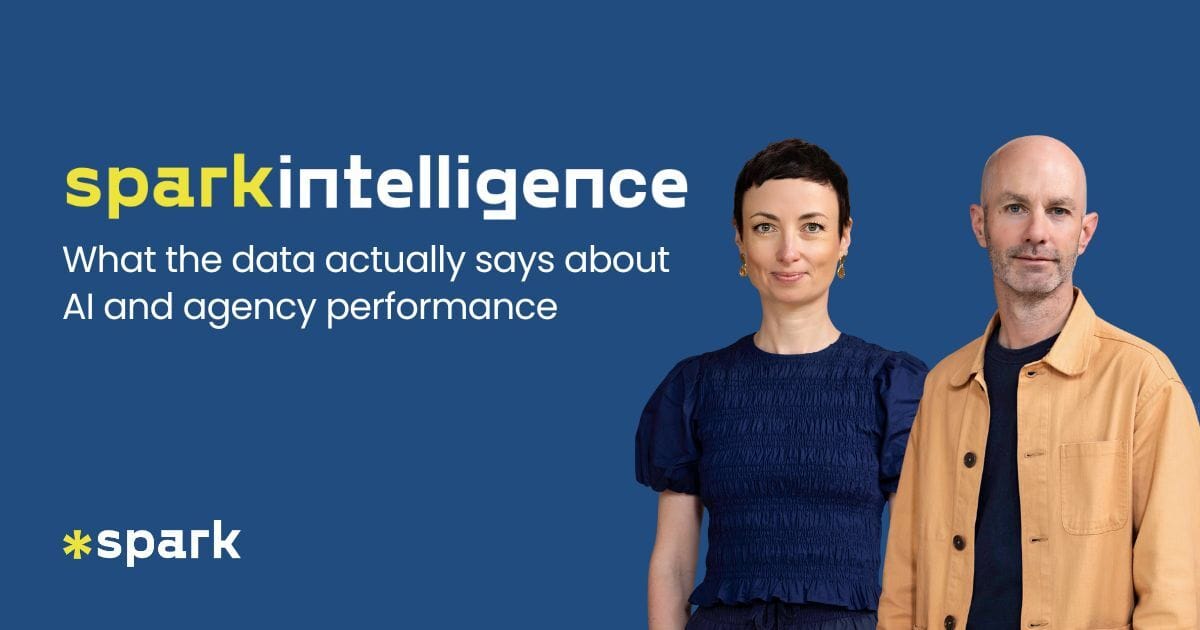
Jules here. Emma handed me the reins this week to tell you about the live conversation I had with Rory Spence from The Wow Company last week.
It was a very useful pairing of perspectives. At Spark, we see AI adoption from the inside: what agencies are actually doing, where they're stuck, what's working. Rory sees what that means for the numbers: growth, margins, valuation. Between us, we can connect the dots.
One topic that got my founder’s antennae twitching: when you’re looking to exit, potential acquirers are now using lack of AI adoption as a negotiation lever. If you haven’t embedded AI properly, you get a lower multiple. More juicy nuggets like this below.
In this edition:
What Rory and I are seeing
Here's something that came through clearly in Rory’s early Benchpress data: over 80% of agency owners say they're confident about AI. But when you look at where agencies are actually using it, no single application area reaches even 50% adoption. And 20% admit to seeing AI as a distraction for their team.
That's a lot of confidence without a lot of consistency.
We see this pattern constantly when we go into agencies. Everyone's using the tools a different way. Nobody has time to learn anything better. Nobody knows what good looks like. And the handful of people excited about AI are running ahead, while others haven't had the time or headspace to catch up.
The insight that surprised us both
Here's where it gets interesting. Rory shared a knockout stat:
Agencies that embedded AI in client delivery and operations grew faster than those who only used it for sales and marketing activities.
It challenges the instinct many of us have to reach for AI as a new business tool first. Yes, AI helps enormously with lead generation, proposal writing, and pitch prep. But the real commercial value comes from doing better work for clients.
That’s why our Accelerator programme has dedicated streams for Client Services, Strategy and Creative - train the teams that actually do the work. AI adoption isn't a software problem. It's an operating model problem. The agencies getting the most from AI are the ones changing how they deliver.
Have your say in Benchpress
These are just some of the early results of The Wow Company's annual Benchpress survey. It closes this week, so if you haven't taken part yet, now's the time. It takes about fifteen minutes, and you'll get early access to the full results when they're published next month.
Margin protection in a tough market
The last couple of years have been brutal for agency profitability. Clients want more for less. Fee pressure is constant. Many agencies have gone through painful restructuring just to stay viable.
But here's where AI creates a genuine opportunity. If you've already got lean, you don't necessarily need to hire your way back to growth. You can lean into AI to deliver more with the team you have, protecting margin while increasing capacity.
One conversation I had at Cannes last year stuck with me. A European production company told me their AI-only productions cost about a third of traditional shoots, but they made higher margins on them. Why? Because they'd invested in training some of their team to be genuinely excellent at AI production, and now have 16 dedicated AI artists. Less competition, more differentiation.
That's the counterintuitive bit. AI can mean lower fees, but it doesn't have to mean lower profit. If you're skilled enough to produce work that clients can't get from others, you can maintain margin even as project costs come down.
What acquirers are looking at
For anyone thinking about exit or investment, AI maturity is now firmly on the due diligence checklist.
Rory was clear on this: buyers want to see documented processes, T&Cs that reflect client needs, clear AI strategies, and proper governance. Not just "we use ChatGPT." They want evidence that AI is being used deliberately, that legal contracts are updated, that there's accountability. According to Benchpress data, only about one in four agencies have actually updated their client contracts for AI. If you haven't, that's a gap to turn your attention to.
Some acquirers are even using AI immaturity as a negotiation lever. If an agency hasn't embedded AI properly, that's grounds for a lower multiple, because the buyer knows they'll need to do the work themselves.
What does good look like beyond the paperwork? It's showing how AI changes the work, not just speeds it up. One agency we've worked with did deep audience analysis for a client, then rather than playing it back as a deck of statistics, they built a simple interactive app where the client could explore how different consumer groups make trade-offs. That's the kind of thing AI makes possible now, and it's the kind of thing that differentiates you in a client's eyes.
The pricing conversation you can't avoid
Clients are increasingly asking agencies to explain how they're using AI. It's appearing in RFPs. It's part of procurement conversations. And behind that question is often an expectation: if AI makes things faster, shouldn't it make things cheaper?
This is where many agencies get stuck. If you're still charging by the hour, AI-driven efficiency works against you. Every hour saved is revenue lost.
Rory made the point well: if you have a senior team who've worked hard for years to get good at something, they'll be quicker than a team of juniors. Does that mean you should pay less because they're good at what they do? Absolutely not. So why would the AI example be any different?
If you find efficiencies through AI and pass all the savings to the client, what is the point? You invested in building the capability. You should share in the value it creates.
Watch the full conversation
If you'd like to go deeper, the full recording of my conversation with Rory is now available.

We cover:
What acquirers and investors are really looking for in AI maturity
How to have the pricing conversation without giving away your margin
The skills shift happening inside agencies right now
Why agency confidence is high but capability is uneven
The stat that shows delivery-focused AI use beats sales-focused AI use for growth
One thing to try this week
Take your current proposal template and rewrite one page using this filter:
Replace "deliverables and days" with "decisions and evidence."
Instead of listing what you'll produce and how long it takes, answer these questions:
What decisions will we enable the client to make?
What evidence will we generate to support those decisions?
What risk will we reduce?
Then add a short "Responsible AI" box: the tools you use, your guardrails, human oversight points, and your paper trail policy.
One page. It transforms the conversation from selling time to selling value.
If this is landing
If any of this resonates and you'd find it useful to talk through where your agency sits, we're happy to help. Our AI Accelerator programme is designed for exactly this transition: from fragmented AI experimentation to embedded capability. But even if you just want to sense-check your thinking, reply to this email or grab time with Emma.
That's all for this edition. Let me leave you with one last thing: Rory shared a phrase from Steve Parks at Convivio that's stuck with me: "Stop doing more stuff and start doing stuff more." It applies to AI adoption as much as anything else. Pick the thing that's going to make the biggest difference and invest properly in getting it right.
Normal service resumes next week when Emma takes the reins back.
See you then,
Co-founder, Spark AI
What did you think of our email today? |
About Spark AI
Spark AI empowers creative and brand leaders turn AI curiosity into confidence through structured training and business transformation.
We have worked with 60+ agencies running AI Fundamentals workshops and AI Accelerator programmes based on our # 1 bestselling book Shift – AI for Agencies.
Trusted by Oxford University Saïd Business School and backed by Innovate UK.