- Spark Intelligence
- Posts
- Spark Intelligence #36: What kind of AI leader are you? Plus six tips to future proof in 2026
Spark Intelligence #36: What kind of AI leader are you? Plus six tips to future proof in 2026
The AI brief for creative leaders to grow your business and career, by Spark AI

Emma Wharton Love
January 05, 2026
👋 Greetings earthlings,
Happy New Year from me, Emma and the whole Spark AI team. I hope you had a proper break and are returning with at least some of your batteries recharged.
January is the month when many of us will tell ourselves "this is the year we get serious about AI." The roadmaps get drafted. The tools get trialled. And by March, most of it has quietly drifted back into the "when we have time" pile.
After supporting 60+ businesses to adopt AI, we've seen agencies fall into four distinct archetypes when it comes to their approach to AI. Not based on size, niche, sector or budget - instead based on knowing what problem they are we actually trying to solve with AI. Knowing the answer to this shapes everything: your priorities, your training approach, your pricing, your differentiation; what success looks like.
We've mapped out each archetype below. As you read, ask yourself: which one feels like us? Which captures how we talk about AI when we're being honest? That's your starting point to guide you where to focus this year.
Also in this edition: My co-founder Jules's six top tips to kick off your AI strategy this year - from his interview with Business Insider last week. Plus a preview of our upcoming webinar with The Wow Company on AI, agencies, and value in 2026.
What's inside:
1. The four AI archetypes
Through working with leaders of boutique studios to global networks, we've noticed that agencies approach AI with vastly different motivations, fears, and definitions of success.
So we asked ourselves: what do agency leaders actually want from AI? Not their favourite tool. The outcome for their business. To find out, we fed everything we've learned across hundreds of touchpoints - workshops, calls, coaching sessions, events - into a custom-built prompt engine, then had a (brilliant human) anthropologist make sense of it all.
Four distinct archetypes emerged. Are you the Creative Differentiator or the Systems Architect? The Operational Realist or the Performance Engine?
I thought you might find this fascinating - and I think it's important to be self-aware about which one you are. You might see yourself in all of them, but you'll have a dominant trait. And that trait shapes everything: your priorities, your training approach, your pricing - ultimately what success looks like.
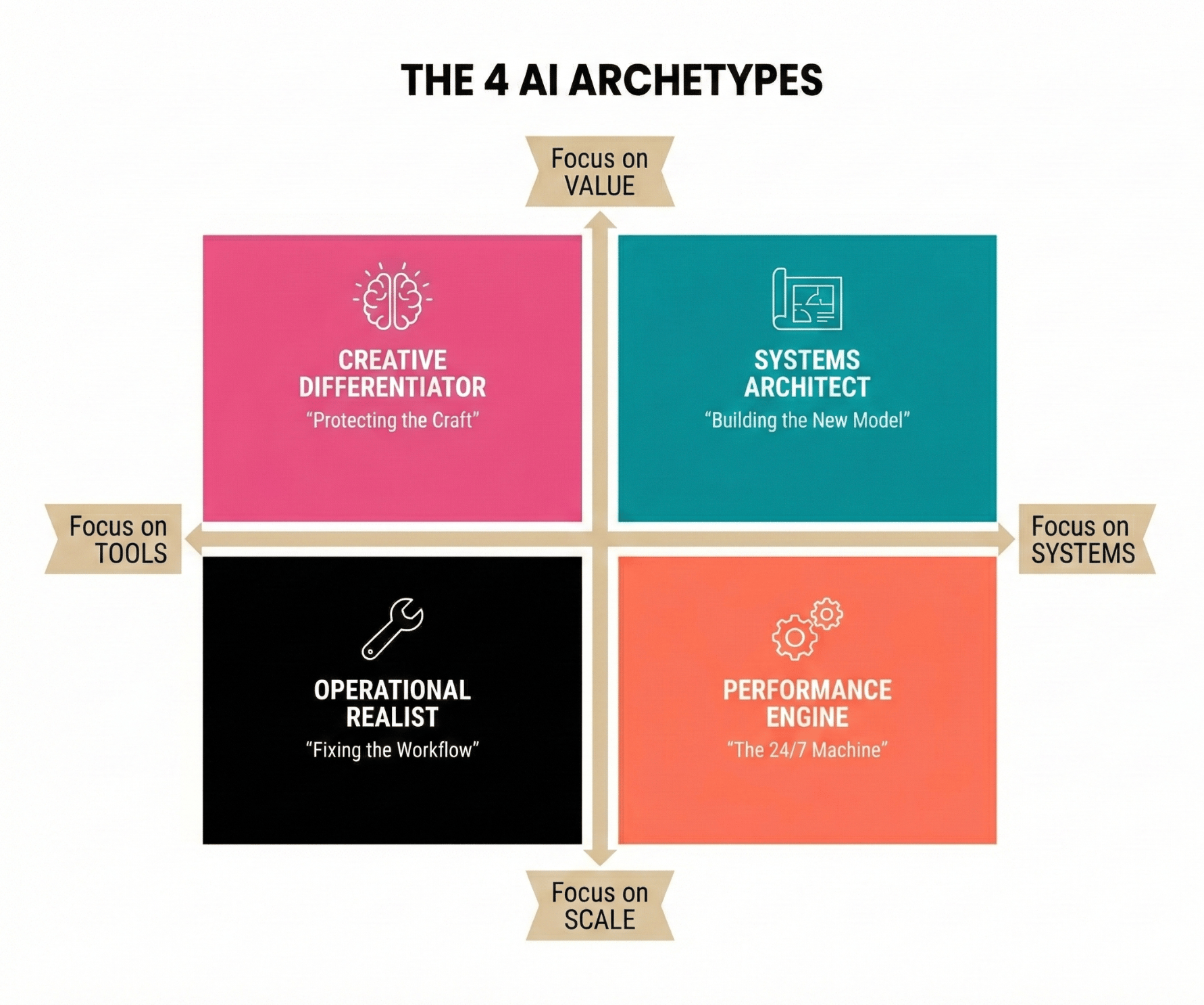
We placed everyone on 2 axes. The first: are you focusing on better work, or on efficiency of existing work? The second: are you focused on training your team and giving them the tools, or building proprietary systems? Put these two axes together, and our 4 archetypes emerge. These align well with what we see on our calls and in our leadership workshops. Let’s dive into each.
To make sense of these 100+ conversations, we plotted every leader’s vision along two critical strategic axes. First, the Value vs. Scale Axis: are you using AI to elevate the quality of your output (better work), or are you focused on the volume and efficiency of your existing output (more work)? Next, the Tools vs. Systems axis: are you empowering individuals with AI tools to use at their discretion, or are you re-engineering your business around proprietary systems? When these two tensions come together, four distinct archetypes emerge. Each represents a different philosophy on the future of work:
1. The Creative Differentiator - "Protecting the Craft"
This archetype sits at the intersection of Value and Tools. If you fall here, your business model relies on unique, bespoke thinking, and you view AI as a "bicycle for the mind" (to steal a phrase from Steve Jobs).
The Mission: Your goal is to enhance quality without losing the DNA that makes your work distinct. You want to give your best people the best tools to produce work that humans alone couldn't achieve.
The Challenge: You are focused on upskilling your team so they can use AI as an engine for their imagination. You want them to explore more creative routes, create new experiences, and craft higher-performing work.
The Hidden Fear: You worry about clients who see AI purely as a cost-cutter and expect reduced fees. You also fear that generic AI outputs or small mistakes could undermine your reputation for precision.
The Breakthrough: You need deep skills with creative AI tools and a new vocabulary to justify premium fees in an automated world. Success requires training, robust governance and QC frameworks that keep quality high and governance robust.
2. The Operational Realist - "Fixing the workflow"
This archetype sits at the intersection of Scale and Tools. You are focused on the immediate mechanics of the day-to-day: prompts, tools, and time-saving.
The Mission: Your goal is to remove the "grunt work" from the daily grind. You want to give teams their time back by optimising existing workflows - from status reports and scheduling to research and timesheets.
The Challenge: Your big opportunity is moving from ad-hoc, "under-the-desk" usage to agency-wide AI Assistants with clear, safe guardrails.
The Hidden Fear: You worry about a fragmented workforce where mixed levels of AI competence lead to inconsistent results. You fear spending time and money building systems that people simply won’t adopt, or facing complex processes that can’t be streamlined.
The Breakthrough: You need a focused AI Taskforce which you give real budget and authority to that maps your workflows to identify where specific AI assistants can help. Success requires them executing a structured plan for scalable implementation, a leadership team unified around it, and the skills or partnerships to build those AI assistants.
3. The Systems Architect - “Building the new model”
This archetype sits at the intersection of Value and Systems. You recognise that the era of selling time is ending and are actively restructuring to sell solutions rather than billable hours.
The Mission: You aren’t just looking for better tools; you are looking for a better company. Your goal is to build unique, high-value ecosystems that redefine what clients actually buy from you.
The Challenge: Your opportunity lies in shifting from a service provider to a solution provider. You want to sell the proprietary systems that generate the work, not just the work itself.
The Hidden Fear: You fear that your output will become generic if you rely on standard, off-the-shelf tools. You also recognise the radical difficulty of bringing your workforce along on such a massive structural shift.
The Breakthrough: You need the thinking partner to develop your new model, the skills and partnerships to build the systems, and a roadmap that empowers your team. Your focus must be on moving the needle from billing for "how long it took" to selling "what it achieved".
4. The Performance Engine - “The 24/7 machine”
This archetype sits at the intersection of Scale and Systems. If you fall into this category, you aren't just looking for a "productivity hack" - you are building an industrial-grade engine.
The Mission: Your goal is maximum output with minimum friction for high-volume, global production. You are building systems to reach scales that were previously impossible, driven by aggressive targets and financial returns.
The Challenge: Your biggest hurdle is finding the specific technical skills to build these engines. You need to ensure that high-volume, automated content remains on-brand and compliant without requiring a human to manually review every single piece.
The Hidden Fear: You worry about a workforce that is hesitant to embrace a shift that market competition has already made non-negotiable.
The Breakthrough: To succeed, you need a cultural shift that frames AI as an urgent commercial necessity. The key is showing your team that efficiency gains will be reinvested into reducing burnout and improving work quality, rather than just cutting costs.
So which are you?
Most agencies have a mix of archetypes across their leadership team. But there's usually a dominant mode. Get alignment around what AI means for your agency and that mode should shape your priorities for the year ahead.
The worst thing you can do is adopt the strategy of a different archetype. A Performance Engine trying to protect craft will confuse its team. A Creative Differentiator forced to focus on scale will erode its positioning.
Know what game you're trying to play. Then focus on playing it well.
There are now more than 2000 of us in the Spark Intelligence community. I’d love to hear which archetype you identify with. If I get enough responses (but you guys are usually pretty quiet responding to my polls!) I’ll play back the results next week.
Which AI archetype do you feel most aligned with? |
Ready to turn this into action?
Our 3 month AI Accelerator programme supports agencies move from expensive, ad-hoc experimentation to aligned, strategic capability. Based on your archetype we can then support you further - from creative AI upskilling, bespoke system builds, to operational automations.
We're now booking for April cohorts of AI Accelerator (Q1 is choka!) and slots fill quickly.
If you want to explore what a programme could look like for your team, book a call with us for a bit of advice.
2. The six ways to future-proof in 2026
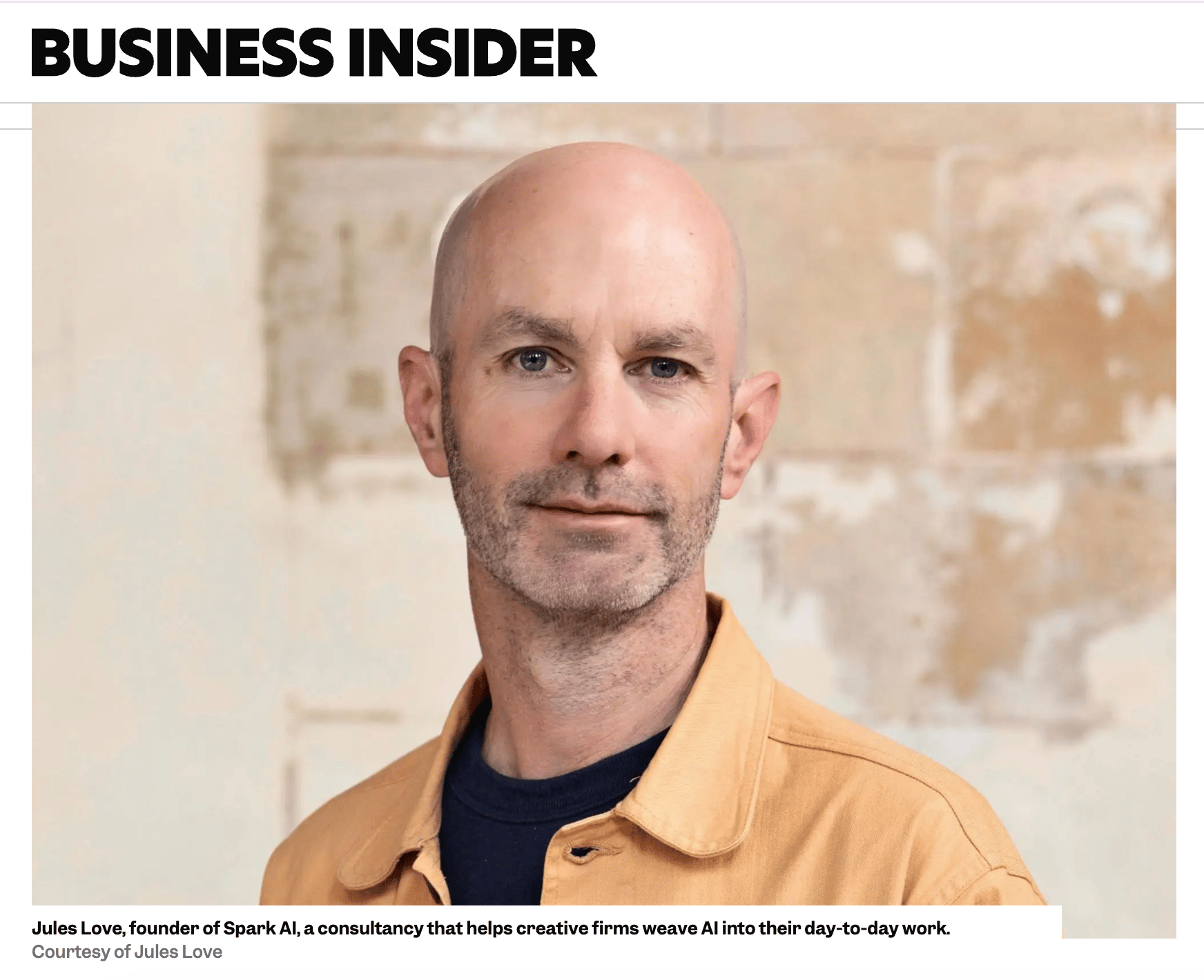
My co-founder Jules was featured in Business Insider last week with practical advice for agencies navigating AI in 2026. Here's the summary of Jules’s top 6 tips to get off to a flying start:
1. Build an AI taskforce, not a tech committee. Make someone accountable. Protect their time. Treat AI as a core business priority, not a side project.
2. Make training role-specific. Generic rollouts leave teams staring at a giant box of Lego with no instructions. The instruction manual is role-specific training.
3. Encourage play and make it policy. Fear kills innovation faster than bad tools. Create structured time for experimentation. Companies like Canva paused normal work for a full week to rethink AI workflows.
4. Replace fear with ownership. If your team feels the need to hide their AI use, something is wrong. Make it visible. Make it normal. Push responsibility down.
5. Shift your thinking. Treat AI like briefing a colleague, not asking a search engine. Real gains come from context and iteration, not quick prompts.
6. Start small, but measure impact. Don't just do more stuff faster. That's a race to the bottom on fees. Focus on better outcomes, not just velocity.
Read the full article in Business Insider
Want to go deeper?
Jules's book Shift - AI for Agencies covers all of this and more. It hit #1 across 8 Amazon categories and is the practical guide for agency leaders figuring out what to actually do with AI.
*Shift – AI for Agencies is also available at Waterstones, Hatchards and all other good booksellers
3. Coming up: AI, Agencies & Value in 2026

Speaking of Jules, catch him in conversation with Rory Spence, Commercial Director at The Wow Company later this month to learn about what AI really means for agency value, margins, and operating models this year.
We are just finalising the details - if you want to make sure you don’t miss it, register your interest below and we will keep you posted.
if you want to make sure you don’t miss it, register your interest here: |
That’s all for today. I hope it’s been a useful kick-start to 2026!
Co-founder and CEO of Spark AI
What did you think of our email today? |
About Spark AI
Spark AI empowers creative and brand leaders turn AI curiosity into confidence through structured training and business transformation.
We have worked with 60+ agencies running AI Fundamentals workshops and AI Accelerator programmes based on our # 1 bestselling book Shift – AI for Agencies.
Trusted by Oxford University Saïd Business School and backed by Innovate UK.